Compare








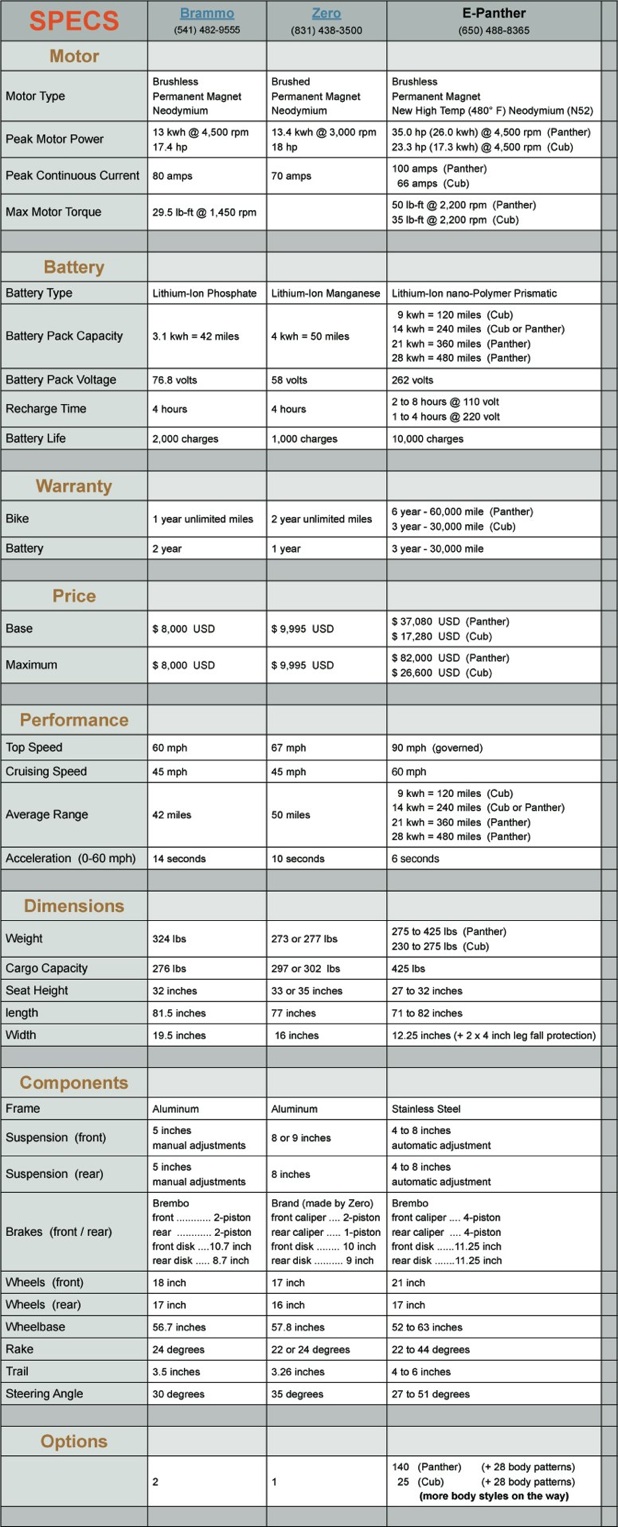
_______________________________________


BODY STYLES
We just finished another seat style
and more body styles are on the way.
____________________________________________________________________________________________________
BATTERY
Many people claim long ranges from their batteries.
There is a lot of smoke-and-mirrors out there,
so here is a lesson to keep in mind ....
_____________________________________________________
Capacity
• Lithium-Ion battery technology is rapidly changing.
The direction is "Nano-Tech" to increase the surface area
to allow for higher capacity and quicker charge times.
• The downside is that turning the Lithium into a "nano-pore sponge"
also makes Lithium ( brittle metallic salt ) a lot more fragile.
Fragile may be fine if the battery is stationary, but not fine in a vehicle.
• Labs are working to coat the "Lithium Sponge" to strengthen it.
Alumina coatings are most often tried.
( our NASA designed batteries us a flexible nano-polymer coating )
• As you charge a Lithium Battery, the Lithium swells.
If you charge the battery too much, it creates small fractures
which greatly reduces the overall life of the expensive battery.
• An average laptop computer battery is lucky to last 2 years
Vehicle batteries are expensive and need to last at least 6 years.
We use a special Nano-Polymer (flexible coating) Prismatic design
made especially for NASA. ( a bit more expensive, but reliably worth it )
Our batteries have an expected life of at least 8-10 years.
( Theoretically 15 years )
Charge Rate
• The other problem is charging too fast.
This causes "hairs" to form on the anode ( the major cause of fires ).
The solution is to charge slower and in layers ( pump charging ).
• We have been in constant contact with M.I.T. and Stanford
and with Stanford's sister lab in Korea.
Both Stanford and M.I.T. have been working on this anode problem.
They are both exploring impregnating anodes with Carbon-NanoTubes.
The Future
• M.I.T. just announced that while using the Carbon Nano-Tube anode,
they have achieved a 10 fold increase in overall capacity.
This is the same increase that both Stanford and Korea predicted.
( we are a bit skeptical .... the devil is in the details )
• It will be a while before such advances leave the lab and reach the market,
but as soon as we feel that any new changes are RELIABLE ENOUGH,
we shall incorporate them in our electric bikes
so you can always be assured that the Electric Panther
is as advanced and reliable as possible .... Always.

ELECTRIC MOTOR
Brushes
• To offer the quietest and lowest maintenance motor, we opt for a brushless design.
-
1. No whiney noises
-
2. no burned ozone smell from the brushes
-
3. no brushes to replace.
Magnets
• To make sure it is the most efficient possible,
we use the most powerful type of permanent magnet (Neodymium).
There are many strengths of Neodymium
and most the much less powerful and less expensive "Bonded' type.
We are the only ones that use the very expensive "Sintered" N52 version.
in order to have most efficient motor possible.
• If an electric motor gets hot, the magnets can de-magnetize (Curie Temperature),
Standard Neodymium demagnetizes at around 300 º F
so the motors are generally forced to run under capacity
or forced to use the added complexity and maintenance of liquid cooling.
• We are using a very special and just invented super-high temperature Neodymium
They are stable to a remarkable 480º F (250º C).
____________________________________________________________________________________________________








_____________________________________________________________________
© 2014 Erik Brinkman.com, All rights reserved
WebSite made for SAFARI Browser